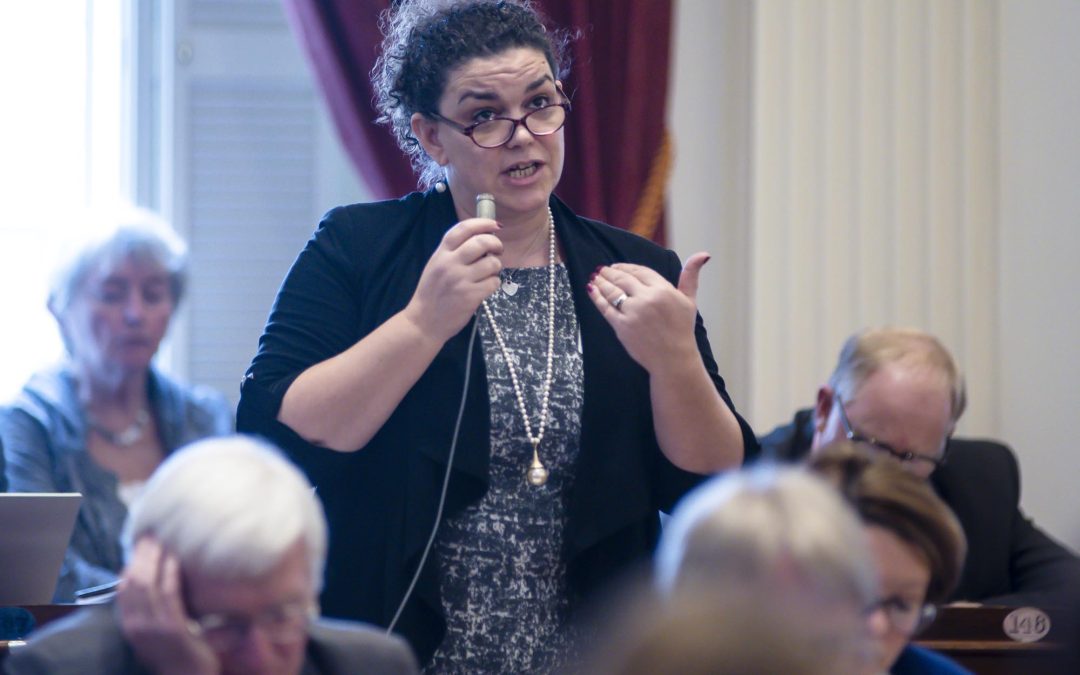
Rep. Laura Sibilia (I-Dover), speaks on the House floor in February 2020. Photo by Glenn Russell/VTDigger
Artificial intelligence is booming. Cloud computing is expanding. And across the country, massive data centers are being proposed and built at a rapid pace. These are facilities that can consume as much electricity as small cities and require significant water, land, and grid infrastructure.
Vermont doesn’t currently have a large-scale data center proposal on the table. But lawmakers are asking a proactive question: What happens if one comes? And more importantly, does Vermont have the protections we need to ensure our environment and our energy rates aren’t affected?
This week on the Democracy Dispatch podcast, we’re talking about two different legislative approaches aimed at preparing Vermont for that possibility. One would establish a regulatory framework for siting and reviewing data centers before they arrive. The other would place a temporary pause, or moratorium, to give the state time to study the impacts and craft long-term policy.
At the heart of this debate are some big questions. How do we balance economic opportunity with environmental responsibility? How do large energy users affect grid reliability and ratepayers? And how does data center development align, or clash, with Vermont’s climate and clean energy goals?
We also take listener questions and dig into testimony from utilities like Green Mountain Power, which suggested that bringing a heavy energy load onto the system could potentially lower rates by spreading fixed costs across more customers. Is that a benefit? A risk? Or both?
Joining me to break this down are Senator Rebecca White (D-Windsor) and Representative Laura Sibilia (I-Dover), who are leading these efforts in the Legislature.
Also on the episode, I give updates on two bills. The first, H.710, that passed the House on a vote of 108 to 30, which clarifies that if several energy-generating facilities use the same technology, such as solar arrays, and are located on the same parcel or on neighboring parcels, the Public Utility Commission could treat them as a single facility, reducing red tape for expanding clean energy. The other bill, S.218, passed the Senate on a vote of 29-1, will set up a new Chloride Contamination Reduction Program aimed at reducing salt pollution in state waters.