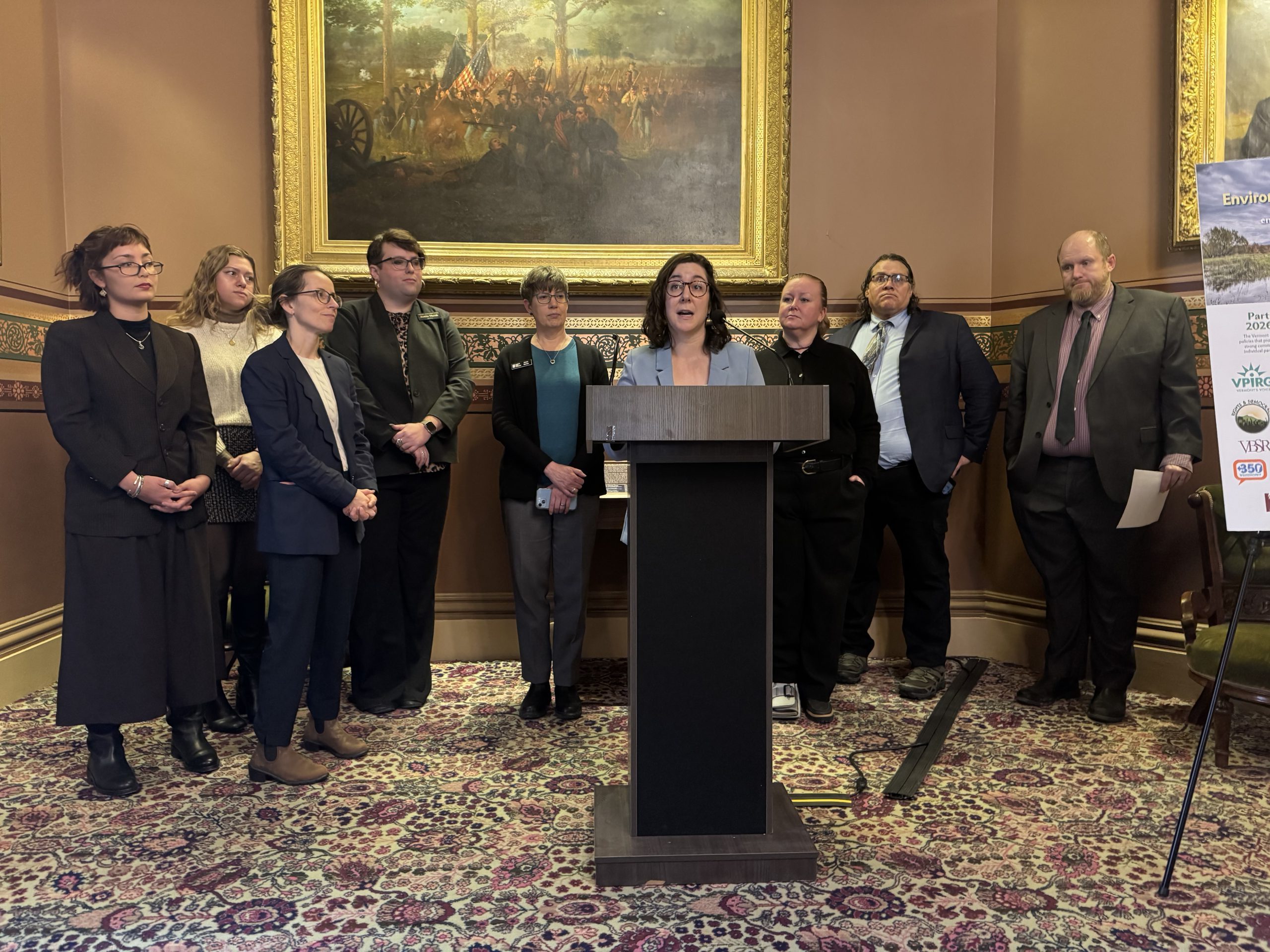
Kati Gallagher, Sustainable Communities Program Director for VNRC speaks at the 2026 Environmental Common Agenda Press Conference. Photo: Courtesy VNRC
Vermont Conservation Voters (VCV) has released the 2026 Environmental Common Agenda, which lays out this year’s top legislative priorities for the Vermont environmental community. VCV releases the Common Agenda every January when the legislature convenes in partnership with other environmental advocacy organizations from across the state. This year, more than two dozen organizations participated in the process of developing and setting the agenda, with 22 organizations signing on as partners of the final agenda – the largest coalition yet.
After nearly one year under the second Trump administration, federal funding and bedrock environmental laws are at risk. Vermont is faced with the reality of reduced funding, increased cost of living, widening income inequality, and the loss of protections that safeguard resilient communities and a healthy environment. When policies like the Clean Water Act, Clean Air Act, and Endangered Species Act are undermined, it could leave holes in critical protections that Vermont must fill to protect our rivers, lakes, air quality, and wildlife.
“We won’t stop advocating for the policy solutions that balance the range of needs facing all Vermonters with the ongoing importance of environmental protections that we rely on for clean air to breathe, clean water to drink, communities protected from floods, renewable energy, and everything that makes Vermont the state we love to live in,” stated Dan Fingas, executive director, Vermont Conservation Voters. “The environmental community and our allies are united behind ensuring that Vermont continues to pass policies that make Vermonter’s lives better.”
In this year’s Environmental Common Agenda, the environmental community has highlighted a range of solutions to continue working toward a healthy democracy, smart growth housing and conservation solutions, affordable clean energy, better transportation options, and toxic-free communities.
The first goal outlined in the 2026 Environmental Common Agenda is to protect and expand Vermont’s free, fair, and accessible democracy. A healthy environment depends on a healthy democracy. When Vermonters can participate fully and freely in our government, better decisions for our communities, our natural resources, and future generations can be made.
“Democracy is not separate from environmental protection, it’s foundational to it. Decisions about clean water, clean air, land use, energy, and climate resilience are only as good as the systems that allow people to have a voice in shaping them,” added Justin Marsh, political director, Vermont Conservation Voters. “Vermont has shown that free, fair, and accessible elections are possible. As democracy is under attack across the country, Vermont has both the opportunity and the responsibility to move forward with protecting and expanding access to the ballot so every voter can participate fully.”
The agenda also outlines a goal to build resilient communities. This can be achieved through strategic conservation and development that encourage smart growth housing and transportation solutions, as well as supporting flood resilience and food security.
“Vermonters deserve thriving, affordable, and resilient communities, and we can get there by planning smarter about where and how we grow,” said Kati Gallagher, sustainable communities program director, Vermont Natural Resources Council. “By supporting compact, walkable, mixed-use communities, we can expand housing options, strengthen local economies, and reduce climate pollution, while conserving the natural lands that protect biodiversity and our ability to be resilient in the face of a changing climate.”
“The path to clean transportation is vital for the economy and health of Vermont. Vermont needs to boldly rethink how transportation dollars are raised and appropriated to meet today’s economic and environmental challenges. Supporting investments in transit, active transportation, electric mobility, and smart housing development will improve Vermonters’ lives and make our downtowns and village centers vibrant communities,” said Robb Kidd, chapter director, Sierra Club Vermont.
“When people are not able to meet all of their basic needs at the same time, hunger is the result, and hunger has been on the rise in Vermont over the past three years,” said Anore Horton, executive director, Hunger Free Vermont. “VCV’s Common Agenda powerfully connects food security to the safety, sustainability, climate resiliency, and democratic access we all need to thrive in Vermont, and Hunger Free Vermont is proud to be a partner in its fulfillment.”
Vermonters deserve clean water, fresh air, safe products, and healthy food. That’s why it’s critical that we reduce Vermonters’ exposure to toxic chemicals like pesticides and plastics that pollute our environment and harm Vermonters’ health.
“Vermonters care deeply about the place we live – it’s part of who we are. That’s why it is critical that we continue to reduce our exposure to toxic chemicals and stop plastics pollution at its source,” said Anna Seuberling, environmental advocate, Vermont Public Interest Research Group. “Toxic chemicals in IV tubing. Plastics in our forests and in our bodies. Dangerous, unnecessary pesticides put farmers at risk. I can’t imagine anyone choosing this future – and the good news is, we don’t have to.”
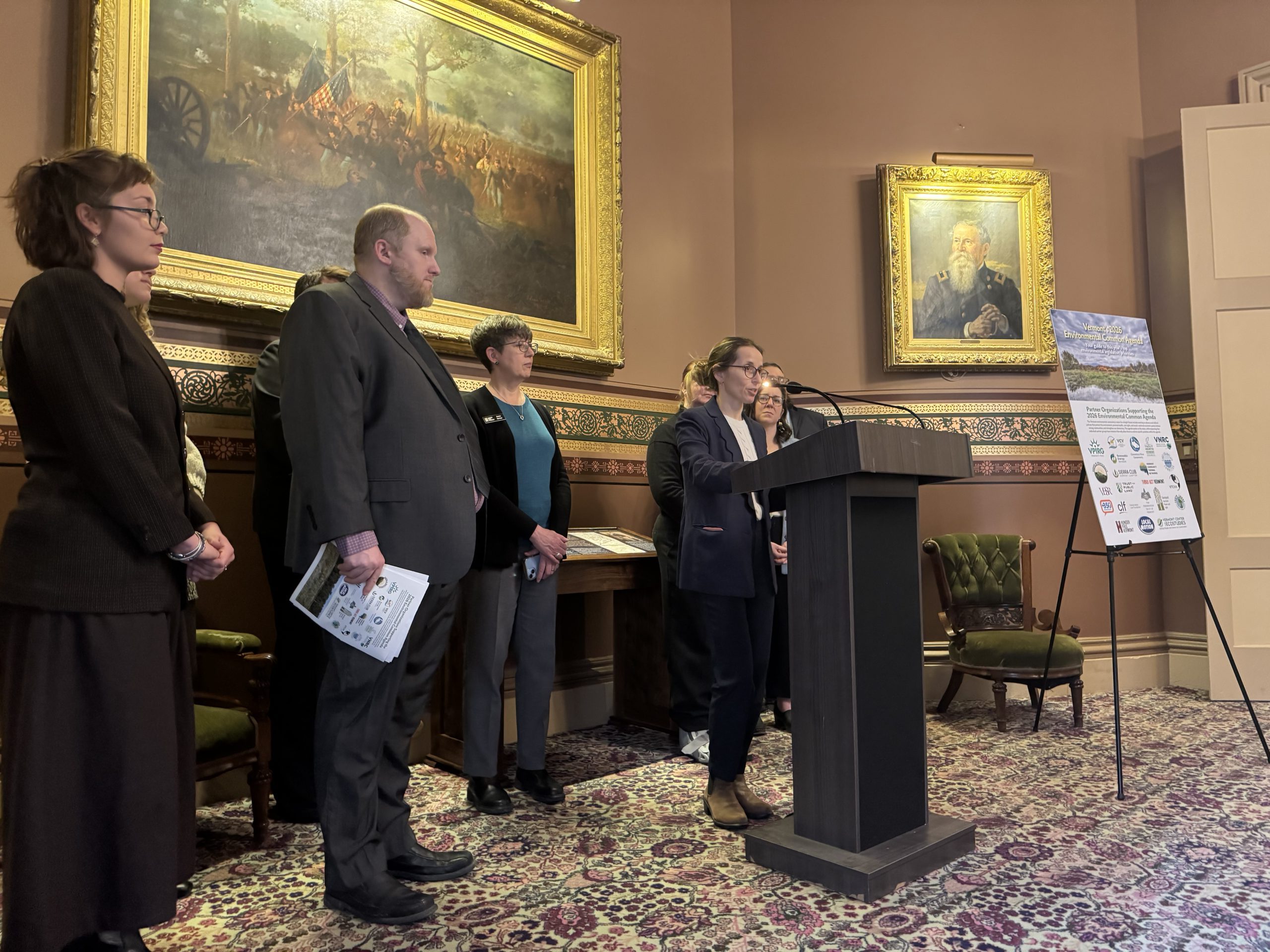
Elena Mihaly, Vice President for Vermont at the Conservation Law Foundation speaks at the 2026 Environmental Common Agenda Press Conference. Photo: Courtesy VNRC
Vermont has reached a tipping point where solar and wind clean energy is the most affordable energy to bring online and electric vehicles and heat pumps are cheaper clean solutions for Vermonters long-term. Our state government can play a pivotal role in helping people access these beneficial technologies through well-crafted policies and incentive programs. In Vermont’s Climate Action Plan, there are a range of climate solutions for lawmakers to consider to advance an affordable clean energy future.
“Energy costs are so high that heating is forefront on my mind,” said Elena Mihaly, vice president for Vermont, Conservation Law Foundation. “And I know too many Vermonters feel the same, having to choose between a warm home and other necessities. We need state leaders to step up with policies that lower upfront costs, slash energy bills, and invest in affordable clean energy for lasting savings.”
Lawmakers and advocates will convene this week to walk through the agenda and discuss the top priority environmental issues. A press conference was held earlier today in the Vermont State House. This evening a reception will be held at Capitol Plaza’s Montpelier Room, 100 State St in Montpelier at 4:30pm. A webinar will be held on Thursday, January 15 at 12pm. To register or for more information, visit vermontconservationvoters.org.
The 2026 Environmental Common Agenda can be found here.
The Environmental Common Agenda is a project of Vermont Conservation Voters, with participation from the following partner organizations (* indicates a new partner in 2026): Connecticut River Conservancy (CRC), Conservation Law Foundation (CLF), Hunger Free Vermont*, Lake Champlain Committee (LCC), Local Motion*, Preservation Trust of Vermont, Renewable Energy Vermont (REV), Rights & Democracy (RAD), Third Act Vermont, 350VT, The Trust for Public Land (TPL), Vermont Businesses for Social Responsibility (VBSR), Vermont Center for Ecostudies*, Vermont Chapter of the Sierra Club, The Vermont Climate & Health Alliance, Vermont Community Thermal Networks, Vermont Conservation Voters (VCV), Vermont Council of Trout Unlimited, Vermont Interfaith Power & Light (VTIPL), Vermont Natural Resources Council (VNRC), Vermont Public Interest Research Group (VPIRG), and Youth Lobby*.