Today, Vermont Conservation Voters (VCV) released the Vermont Congressional delegation’s scores for the League of Conservation Voters’ 2025 National Environmental Scorecard, which highlights our state’s leaders’ work to protect our environment and democracy. Since 1970, LCV’s Scorecard has been the primary tool for evaluating the environmental records of members of Congress. It is available for download at: scorecard.lcv.org
The 2025 Scorecard highlights Vermont’s leaders’ work to protect our environment despite an unprecedented year with a record number of attacks on our environment and democracy. Our delegation fought against Republicans in Congress who repeatedly chose loyalty to the Trump administration and Big Polluters over making life more affordable, safer, and healthier for their own constituents. The result has been higher energy costs for working families, lost jobs and economic opportunities, the selling of tens of millions of acres of public lands and waters to Big Polluters, fewer clean air and water safeguards, and increased pollution. Congressional Republicans threatened free and fair elections; however, thanks to Senators Sanders and Welch, these efforts were blocked in the Senate.
 “Vermonters should be proud to have leaders who are fighting back against higher costs, more pollution, and attacks on our democracy – and have the scores to show for it,” said Dan Fingas, VCV Executive Director. “Republicans in Congress are making life for millions of working families completely unaffordable. Here in Vermont, we still must pass a state Voting Rights Act, ensure we implement and invest federal dollars so it benefits every community, and support clean energy expansion. At the same time, we need leaders like Senator Sanders, Senator Welch, and Representative Balint to keep fighting for us in Congress. Our future and our democracy are on the line.”
“We’ve never seen a Congressional majority so willfully abandon its responsibilities to protect their own constituents and the Constitution and instead relentlessly attack the health and safety of our communities, our environment, and our right to a free and fair democracy,” said LCV Senior Vice President for Government Affairs Sara Chieffo. “Those members of Congress who voted for the Big Ugly Bill, killed clean energy incentives at a time when energy demand is at all-time highs and energy prices are rising higher than ever. It’s no surprise that while this Congress has been doing the bidding of President Trump and Big Polluters, utility costs rose 13% nationwide last year. We commend the members of Congress who forced votes to protect U.S.-made clean energy, our treasured public lands, critical federal agency funding, and our rights — pushing back on extreme Republican efforts to make it harder for people to vote and hand even more power to Trump.”
The 2025 Scorecard scored votes including amendments showing where members stood on affordable clean energy, manufacturing jobs, public lands, and federal workers on the Big Ugly Bill and its final passage (which LCV double scored), nominees picked solely for their loyalty to Trump and fossil fuels, and Congressional Review Act (CRA) attacks on clean air and water, wildlife, and public lands. Also scored were bills undermining public input on decisions affecting our environment and communities, and the SAVE Act to make voter registration more onerous, for a combined record number of 66 votes in the annual Scorecard undermining the programs and laws that advance a safe climate, environment, and democracy.
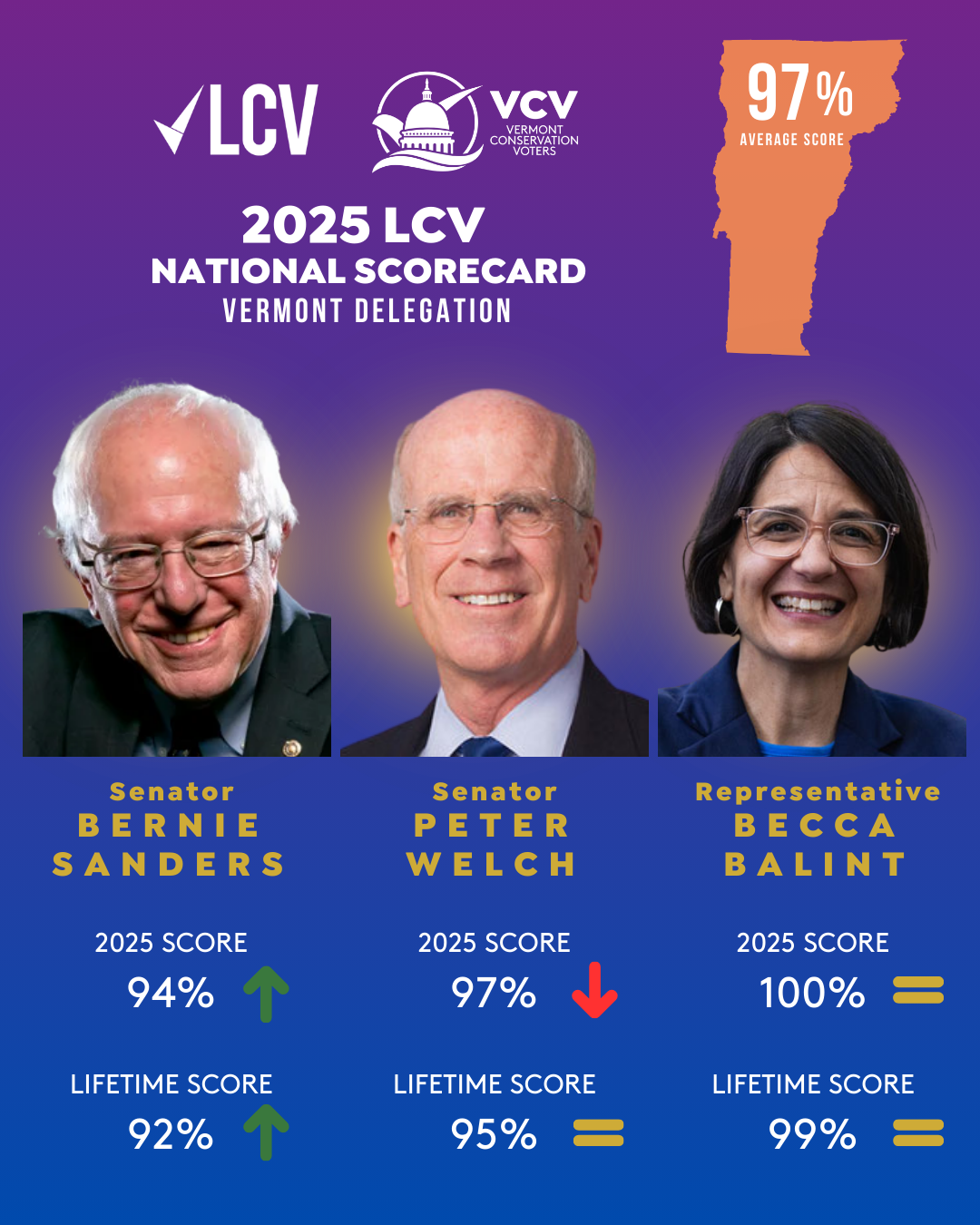
Vermont’s federal delegation’s scores for 2025 are:
Senator Bernie Sanders (I) – 94% (92% lifetime)
Senator Peter Welch (D) – 97% (95% lifetime)
Representative Becca Balint (D) – 100% (99% lifetime)
____
LCV has published a National Environmental Scorecard every Congress since 1970. The Scorecard represents the consensus of experts from more than 20 respected environmental and conservation organizations who selected the key votes on which members of Congress should be scored. LCV scores votes on the most important issues of the year, including energy, climate change, environmental justice, public health, public lands and wildlife conservation, democracy, and spending for environmental programs. The votes included in the Scorecard presented members of Congress with a real choice and helped distinguish which legislators are working for environmental protection. More information on individual votes and the Scorecard archive can be found at lcv.org/2025-scorecard.